
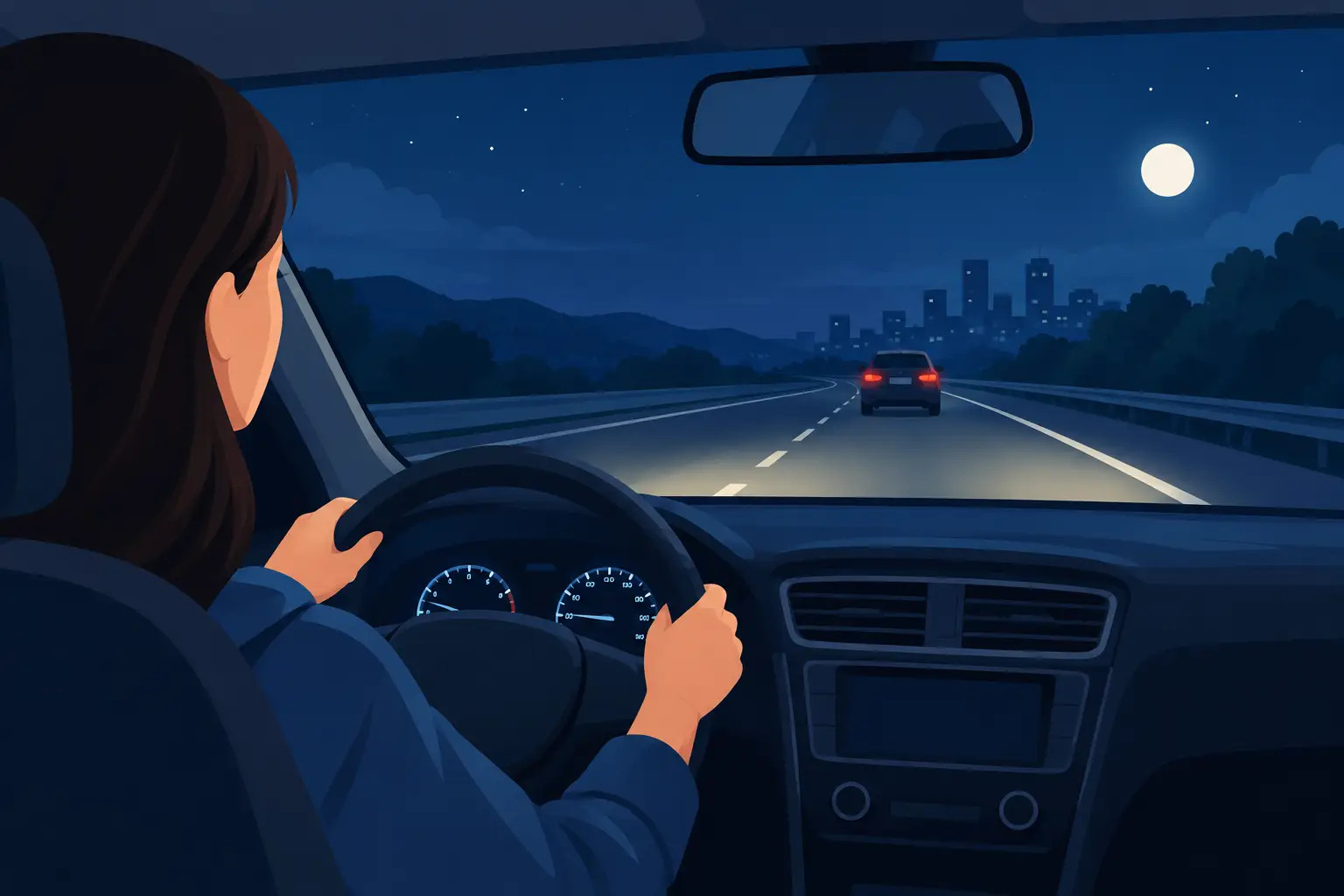
A quiet road can feel easier at night, but darkness removes many of the clues that help a new driver judge speed, distance and hazards. This night driving safety guide is for South Shields learners who want to build confidence without rushing ahead of their experience.
Night driving is not simply daytime driving with the headlights on. You see less of the road, other drivers can dazzle you, and tiredness can affect decisions before you realise it. The aim is not to be fearless. It is to use good observation, sensible speed and calm routines so that you stay in control.
Why night driving feels different
During the day, you can read the road well ahead: parked cars, people near crossings, changes in the road surface and the movement of traffic at junctions. At night, your headlights only show a limited area in front of you. Beyond that, hazards can appear later and feel closer than expected.
Street lighting helps, but it can also create contrast. A pedestrian wearing dark clothing may be difficult to spot between pools of light. Rain reflects headlights and street lamps across the windscreen. On unlit roads, bends, dips and entrances can be harder to judge.
For a learner driver, this means allowing more time. More time to see, more time to think and more time to brake smoothly. There is no benefit in matching the speed of a driver behind you if that speed does not feel safe for what you can see.
Prepare before you set off
Safe night driving starts before the engine does. Check that all lights are working and that the headlights, rear lights, indicators and number plate lights are clean. A thin film of dirt can reduce the light you put onto the road and make it harder for others to see you.
Clean the inside of the windscreen too. Smears that seem harmless in daylight can cause broad streaks of glare from oncoming headlights. Make sure your washer fluid is topped up, your wipers clear the glass properly, and your demister works before you need it.
Set your mirrors and seat as normal, then take a moment to reduce distractions. Put your phone away, choose your route before moving off and make sure you are not already tired. If you have had a long day at college, work or home, it may be better to delay a non-essential journey than to force yourself through it.
Use lights correctly
Use dipped headlights in the dark, including on roads with street lighting if visibility is poor. Sidelights alone are not enough for driving at night. They do not light the road properly and can make your vehicle less noticeable.
Full beam can be useful on unlit roads when there is no traffic ahead and you are not likely to dazzle anyone. Dip your headlights in good time for oncoming traffic, when following another vehicle, and when approaching a bend where your lights may affect a driver you cannot yet see. Check your mirrors after changing your lights, but keep your main attention on the road ahead.
If you are unsure whether full beam is appropriate, dipped headlights are the safer choice. Seeing a little less far is preferable to dazzling another road user.
Manage glare without losing focus
Glare is one of the most common reasons night driving feels uncomfortable. Looking directly into oncoming headlights can leave you temporarily unable to see detail, especially on wet roads.
Rather than staring at the lights, keep your eyes moving and use the left-hand edge of your lane or kerb as a reference when a vehicle approaches. Do not fix your gaze on the kerb for too long – you still need to scan ahead for hazards – but it can help you maintain a safe position while the vehicle passes.
Keep your rear-view mirror in its night setting where fitted. If bright lights behind you are distracting, avoid reacting suddenly. Maintain your lane position, leave a larger gap ahead and find a safe place to pull over if you need a short break. Never let another driver’s impatience persuade you to drive beyond what you can safely see.
Choose a speed for the distance you can see
The speed limit is a maximum, not a target. At night, a safe speed depends on your visibility, road condition, lighting, weather and experience. On an unlit rural road, you may need to drive well below the limit because your stopping distance must fit within the clear road ahead.
This matters particularly when the road bends. Your headlights point in the direction of the car, not necessarily around the corner, so you may not see a cyclist, animal, pedestrian or stationary vehicle until late. Ease off before the bend, select an appropriate gear and be ready to stop. Avoid braking heavily halfway through unless necessary.
In South Shields, residential roads can present different problems. Parked cars narrow the available space, people may step out from between vehicles, and cyclists can be difficult to see. Read the scene early and expect the unexpected near shops, bus stops, crossings and entertainment venues.
Give yourself more space in poor weather
Darkness and rain together demand extra patience. Water on the road can hide potholes, reduce tyre grip and multiply reflections. Brake earlier and more gently, leave a bigger gap from the vehicle in front and avoid sharp steering inputs.
Fog is another situation where speed needs to come down. Use dipped headlights, and use fog lights only when visibility is seriously reduced. Turn rear fog lights off once visibility improves, as they can be very bright for drivers behind. If you cannot see clearly enough to stop safely within the distance you can see, you are travelling too quickly.
A clear windscreen is just as important as clear weather. Use the heater, air conditioning or demister to prevent misting, and pull over somewhere safe if visibility becomes compromised. Wiping a small patch with your hand is not a safe substitute for properly clearing the screen.
Tiredness is a driving risk, not a minor inconvenience
A warm car, dark roads and a repetitive route can make fatigue arrive quickly. Warning signs include frequent yawning, heavy eyes, missed road signs, drifting concentration and not remembering the last few minutes of driving clearly.
Opening a window, turning up music or drinking coffee may make you feel more alert briefly, but none replaces rest. If you are tired, stop in a safe, legal place and take a proper break. Do not stop on the hard shoulder of a motorway except in an emergency, and do not park somewhere that creates a risk for you or other road users.
New drivers can be especially affected because much of their attention is still used by steering, gear changes, mirrors and planning ahead. There is nothing weak about recognising that you are not fit to continue. It is good judgement.
Practise night driving gradually
The best way to gain confidence is through structured practice, not by taking on the hardest journey first. Start on familiar, well-lit roads with an experienced accompanying driver or instructor. Practise the routines that feel different at night: judging gaps at junctions, reading road signs earlier, dealing with glare and choosing when to use full beam.
Then build up to quieter residential streets, busier routes and roads with less lighting. Each drive should have a clear purpose. You might focus on smooth approaches to roundabouts one evening, then safe use of headlights and observation on another.
For manual learners, night driving can also reveal whether gear choice has become automatic enough. You should be able to select a suitable gear without staring at the gear lever or losing awareness of what is ahead. If the workload feels too high, slow the situation down rather than trying to push through it.
A calm instructor can help you identify whether a concern comes from a particular skill, such as approaching an unlit junction, or simply from lack of experience. Recorded progress is useful here: it turns a vague feeling of “I am not ready” into a practical plan for what to practise next.
Night driving before your practical test
You will not take your practical test in darkness, but night practice can still strengthen daytime driving. It encourages earlier planning, better use of mirrors and a clearer understanding of stopping distances. Those habits are valuable when preparing for Sunderland Driving Test Centre, where independent driving still depends on measured decisions and sound observation.
Test readiness should be earned through consistent independent driving, not assumed because a learner has completed a certain number of lessons. If night driving exposes an area that needs more work, that is helpful information, not a setback.
A simple routine for every evening journey
Before moving away, check your lights, windows and mirrors. Once driving, look well ahead, keep a space cushion around the car and make each decision early. If glare, weather or fatigue reduces what you can see or process, reduce speed and increase the gap.
For learners in NE33 and NE34, regular manual lessons can make these routines feel familiar rather than stressful. ProPasser offers patient, structured two-hour lessons for South Shields learners who want to develop safe, independent driving at a pace that is right for them. When you are ready to build night-driving experience, a clear plan and calm practice can make every journey feel more manageable.


