
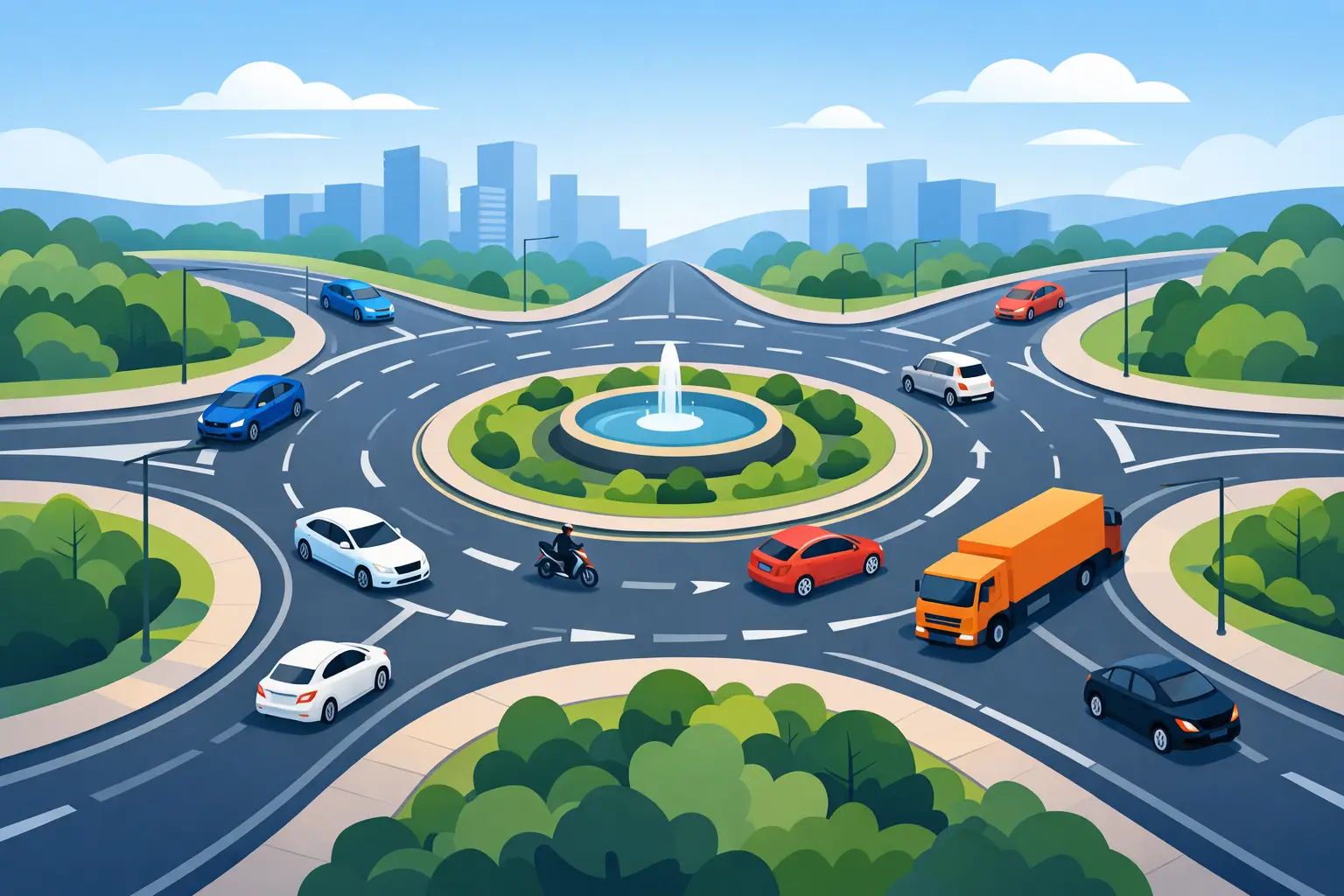
A large roundabout can feel like several decisions arriving at once. There may be two or three lanes, traffic joining from different directions, signs for places you do not know, and drivers who appear to be moving faster than you expect. The good news is that learning how to drive large roundabouts is not about rushing or guessing. It is about slowing the situation down in your mind, reading the road early and following a reliable routine.
For learners in South Shields, larger roundabouts often become more relevant when preparing for routes around Sunderland Driving Test Centre. They are also a normal part of independent driving. With patient practice, they become manageable junctions rather than something to dread.
Start with the signs, not the roundabout
Your decisions should begin well before the give-way line. As you approach, look for the roundabout diagram sign. It normally shows each exit and the destinations or road numbers attached to them. Read it as early as you safely can.
Ask yourself one simple question: which exit am I taking? The answer tells you the general direction – left, ahead, right, or back the way you came – and helps you choose a lane. If you are following a sat nav, listen to the instruction but still check the road signs and lane markings yourself. Sat navs can be late, unclear or unsuitable for the exact layout in front of you.
If you cannot read the sign in time, do not panic. Choose the safest available lane, enter only when it is safe, and continue around the roundabout until you can leave safely. Taking an extra circuit is usually far better than making a sudden lane change or cutting across another vehicle.
How to drive large roundabouts step by step
The same core routine works on most large roundabouts: mirrors, signal, position, speed and look. On a bigger layout, you simply begin the routine earlier and give yourself more time.
Approach at a speed that lets you think
Ease off the accelerator early and use controlled braking. You need enough time to read signs, assess the traffic and select the correct gear. In a manual car, this often means changing down before the give-way line so the car is ready to move when a safe gap appears.
There is no single gear for every roundabout. Second gear is often suitable when traffic is flowing and visibility is good, while first gear may be needed if you have stopped or are moving very slowly. The right gear is the one that gives you control without making the engine labour or race.
Do not feel pressured by a driver behind you. A calm, well-observed approach is safer than arriving too quickly and then braking sharply at the line.
Choose your lane early
For a first exit on the left, you will usually use the left-hand lane and signal left on approach. For an exit to the right or for turning back, you will usually use the right-hand lane and signal right on approach.
Going ahead is where learners can feel less certain. On many roundabouts, the left lane is appropriate for ahead, but road markings and signs may direct you to a different lane. Large roundabouts often have dedicated lanes for particular destinations, so the markings on the road take priority over a general rule.
Look for arrows painted in your lane. If your lane is marked for ahead, stay in it. If it is marked left only, do not use it to go ahead just because it looked convenient at the last moment. Plan early, but accept that sometimes road markings will be partly hidden by traffic. In that situation, stay composed, follow the lane safely and adjust your route later if needed.
Give way properly and judge a safe gap
At the give-way line, look to the right and assess traffic already on the roundabout. Check the speed and position of approaching vehicles, rather than looking only for an empty space. A gap must be safe for your car to enter without making another driver brake or change course.
On a busy multi-lane roundabout, keep checking the lane you intend to enter. A vehicle in the outer lane may be leaving at the exit before yours, while a vehicle in an inner lane may continue around. Do not assume another driver will take the exit their position suggests. Watch their speed, signal and road position, but give them room if there is doubt.
Once you have decided the gap is safe, move positively. Hesitating after a safe decision can create uncertainty for everyone around you.
Keep your lane on the roundabout
The centre of a large roundabout is often marked with lane lines that curve and spiral towards different exits. These guide you from your entry lane towards the correct exit. Your job is to follow your lane, not to cut across it.
Keep your eyes moving. Look ahead along your lane, check your mirrors when preparing to change direction or leave, and remain aware of vehicles beside you. Avoid staring at the kerb, the central island or one particular car. Looking ahead helps your steering stay smooth.
Some larger roundabouts have traffic lights on the approach or while you are circulating. Treat each set of lights as its own controlled junction. A green light does not remove the need to check that your exit is clear, particularly if traffic is queuing beyond it.
You may also meet buses, lorries, cyclists and motorcyclists. Give larger vehicles extra space because they may need more than one lane to turn. Look carefully for motorcyclists filtering through slow traffic, and be especially patient around cyclists, who may take a central lane position to remain visible and avoid unsafe overtakes.
Signal at the right time for your exit
For most exits, signal left after you have passed the exit immediately before the one you want. This gives other road users useful information without signalling so early that it misleads them.
For example, if you are taking the second exit, usually signal left once you have passed the first exit. Check your left mirror before signalling and moving towards the exit, especially where there are cyclists, motorcyclists or vehicles in a lane beside you.
On very large roundabouts, lane signs may direct you towards the exit without a noticeable lane change. You should still use your left signal when leaving if it will benefit other road users. The timing can vary slightly with the layout, which is why observation matters more than trying to apply a rule mechanically.
What to do when you are in the wrong lane
Every driver occasionally finds themselves in the wrong lane. It is not a reason to make an unsafe correction.
If you realise before entering, check whether the lane markings allow you to continue to your intended exit. If they do not, follow the lane you are in. You may take a different exit, continue around if it is safe, or allow the sat nav to recalculate. Never force your way across a solid line, sharply steer across lanes, or stop on the roundabout because you are worried about the route.
This matters on a driving test too. Taking the wrong exit is not automatically a fault. Unsafe driving, poor observation or an abrupt manoeuvre is the concern. Examiners are looking for safe, independent decisions, not perfect navigation.
Build confidence gradually in your lessons
Confidence on large roundabouts is earned through repeated, structured practice. A good lesson should not begin with the most demanding layout before you understand the basics. Start by practising approach routines and lane choice on quieter roundabouts, then build towards busier multi-lane junctions when your steering, clutch control and observation are more settled.
Talking through the plan can help nervous learners. Before approaching, say the exit aloud, identify the lane, then describe when you will signal. As your confidence grows, you should rely less on prompts and make the decisions independently.
At ProPasser, two-hour manual driving lessons give South Shields learners time to practise a route more than once, discuss what happened and improve the next attempt. Progress can be recorded clearly, so you know whether you need more work on signs, gap judgement, lane discipline or calm decision-making before test preparation around Sunderland Driving Test Centre.
A quick check before every large roundabout
Before you reach the give-way line, make sure you can answer these questions: Which exit am I taking? What do the signs and lane arrows say? Which lane am I in? Is my speed and gear suitable? Have I looked properly for traffic and vulnerable road users?
If the answer to one of those questions is unclear, reduce speed and give yourself time. Large roundabouts reward forward planning, not last-second reactions.
The next time one appears ahead, focus on one decision at a time. Read early, choose your lane, wait for a safe gap and follow the road markings. Each calm approach is evidence that you are becoming the safe, independent driver you are working towards.


