
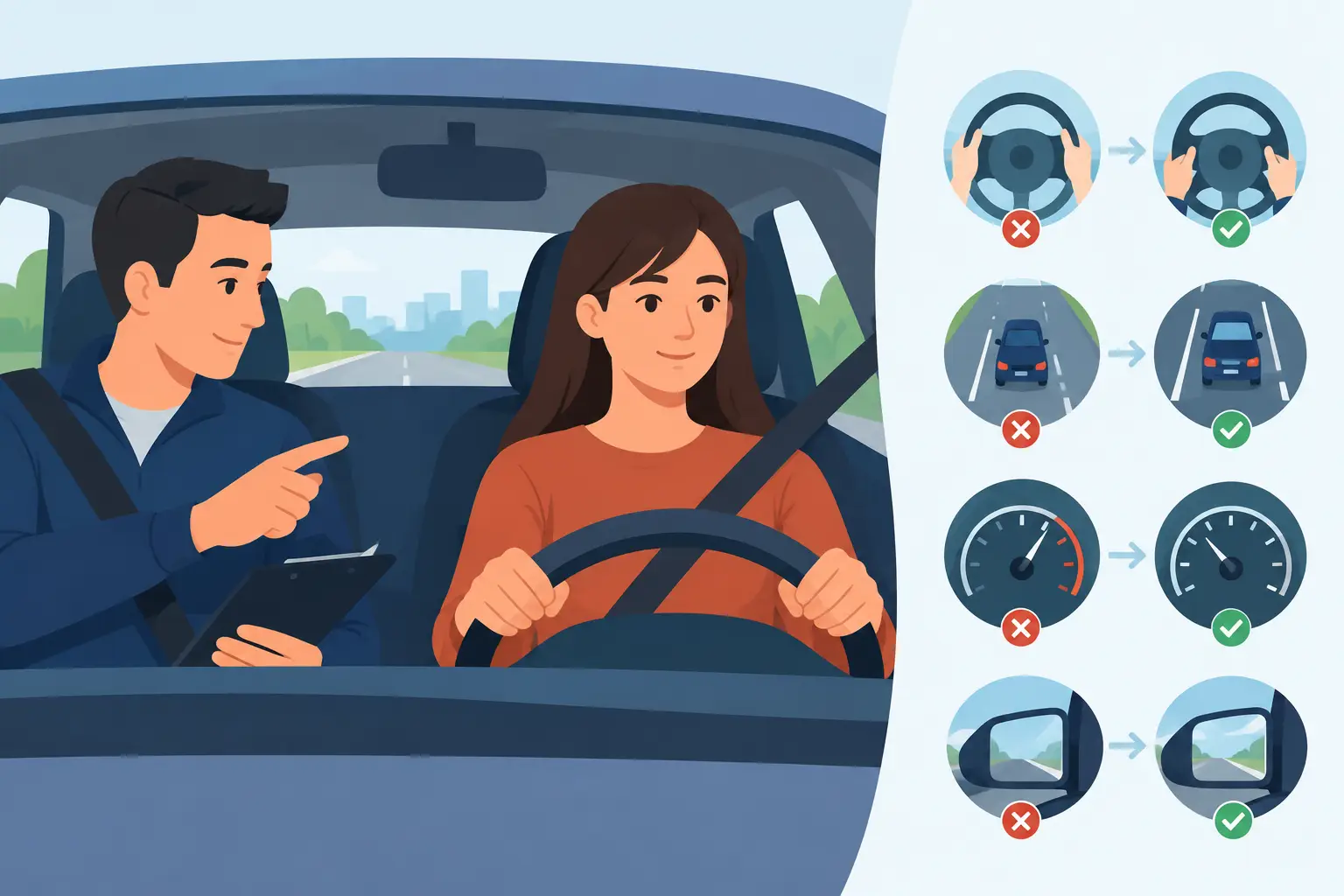
A driving test fault can feel frustrating when you know you are trying hard. Yet most common driving faults are not caused by a lack of ability. They usually happen when a learner is rushed, distracted, unsure of the next step or relying on an instructor’s prompts rather than making their own safe decisions.
The good news is that faults are useful information. They show exactly where your driving needs more practice before you are ready to drive independently. A calm, structured approach helps you replace last-minute reactions with good routines that work on unfamiliar roads as well as familiar ones.
What counts as a driving fault?
During the practical test, the examiner assesses whether you can drive safely and independently. A fault may be recorded where there is room for improvement but no immediate danger. If the same fault happens repeatedly, or if one action puts you or another road user at risk, it can become serious.
This is why simply aiming for a low number of faults is not the best way to learn. The real aim is to understand what you are seeing, plan early and make safe choices without being coached through every situation. Some learners need only a small adjustment to their routine; others need more time to build confidence after a break or a previous difficult experience. Both are normal.
Common driving faults at junctions
Junctions ask you to manage observation, position, speed, gears and other road users at the same time. They are one of the most common places for faults because a learner can be technically competent but still arrive with too little time to assess what is happening.
Approaching too quickly
Entering a junction too quickly can make every later decision harder. You may brake sharply, select the wrong gear, stop beyond the line or pull out before you have a clear view. The fix is not simply to crawl towards every junction. It is to plan sooner.
Look well ahead for signs, road markings and the shape of the road. Ease off the accelerator early, choose a speed that lets you observe properly, and be ready to stop. At a give-way line, do not let pressure from traffic behind persuade you to move before it is safe.
Incomplete observations
A quick glance is not always a useful observation. At roundabouts and side roads, learners can look in the right direction but fail to take in a cyclist, pedestrian, motorcyclist or vehicle approaching faster than expected.
Make your observations purposeful. Ask yourself what is coming, how quickly it is moving and whether your intended gap leaves enough room. At emerging junctions, move forward only when you can see safely. If your view is blocked, edge out carefully and continue looking, rather than committing because you have already started to move.
Positioning and lane choice
Poor position on approach can confuse other drivers and leave you in the wrong lane at a roundabout. This often happens when road markings are noticed too late.
Build the habit of checking signs early, then checking again as you approach. If you realise late that you are in the wrong lane, do not make a sudden correction. Continue safely and allow the route to change if necessary. A wrong turn is usually manageable; an unsafe manoeuvre is not.
Mirrors, signals and moving off
Mirror faults are often described as forgetting to check, but the bigger issue is timing. A mirror check that happens after you have started changing direction does not help you respond to what is already beside or behind you.
Before moving off, changing lanes, turning or slowing significantly, check the mirrors that matter for that action. Include the appropriate blind-spot check when moving away from the kerb. Then act on what you have seen. Seeing a cyclist is only useful if you wait or adjust your position to give them space.
Signals create similar problems when they are late, cancelled too soon or left on accidentally. A signal should help other people understand your intentions in good time. It should not be used as a substitute for checking that it is safe. Practising the routine of mirrors, signal, position, speed and look can make the sequence more reliable, but it must never become something you repeat without thinking.
Speed faults are not always about speeding
Driving above the limit is a clear problem, but speed-related faults also include travelling too fast for wet roads, parked cars, tight bends, busy shopping areas or limited visibility. Driving much too slowly without a reason can also hold up traffic and show hesitation.
The right speed depends on the limit, the road layout and the conditions. A 30 mph limit is a maximum, not a target you must reach at all times. Near a school at finishing time, for example, a lower speed may give you the time and space to react safely. On a clear road, unnecessary slow driving may indicate that you are not yet confident with the flow of traffic.
Regular speedometer checks matter, especially after a change in road type or speed limit. More importantly, learn to read the road. If your view is reduced, if there are vulnerable road users nearby, or if vehicles are likely to pull out, give yourself more time.
Common driving faults with steering and control
Learners sometimes focus so hard on the pedals and gears that their steering becomes tense or delayed. This can lead to wide turns, cutting corners, drifting within the lane or correcting repeatedly on a straight road.
Where you look has a strong effect on where the car goes. Look through the bend or towards the space you want to reach, rather than staring at the kerb, oncoming traffic or a parked car you are worried about. Keep your hands in a secure, comfortable position and make smooth steering adjustments instead of large, late movements.
Stalling is another common concern, particularly for complete beginners in a manual car. A stall is not automatically a serious fault. What matters is how you respond. Secure the car, restart calmly, observe again if needed and move away only when safe. Rushing to recover can create a bigger problem than the stall itself.
Hesitation and decision-making
Waiting when there is no safe gap is sensible. Waiting when several safe opportunities have passed may be recorded as hesitation because it affects the flow of traffic. The difference can be difficult for nervous learners, particularly at busy roundabouts or right turns.
Confidence does not mean taking small gaps. It means recognising a safe gap and using it decisively. This takes practice because judgement improves through repeated experience, not through being told to ‘go’ by an instructor.
On lessons, it helps to talk through what you can see before acting: the approaching vehicle, its speed, the available space and your plan. Over time, that commentary becomes an internal process. You begin to decide for yourself, which is exactly what the examiner needs to see.
Parking and manoeuvre faults
Manoeuvres are not about placing the car perfectly on the first attempt. They are about control, observation and responding safely to the situation around you. A correction is often sensible if it keeps the car well positioned and avoids mounting the kerb or ending too far from it.
The most frequent problems are focusing entirely on reference points, missing pedestrians or traffic while reversing, and steering too quickly. Use reference points as a guide, not a script. They can change with your seating position, the road camber and the space available.
Move slowly enough to keep control and pause whenever you need to assess the area. All-round observations are especially important when reversing. If someone approaches, stop and deal with the situation safely rather than continuing because you are halfway through the manoeuvre.
How to turn faults into progress
A recorded fault should lead to a clear practice plan. Instead of saying, ‘I need to do better at roundabouts’, identify the precise part that caused difficulty. Was it spotting the sign late, selecting a lane late, judging a gap, or checking the left mirror before exiting? Specific feedback makes improvement measurable.
Structured two-hour lessons can give you time to revisit the same skill in different conditions rather than rushing from one topic to another. Keeping a record of progress also helps you see patterns and avoid practising only the parts you already enjoy. If you are changing instructor or returning after time away, this can make your starting point clearer and less daunting.
For South Shields learners preparing for Sunderland Driving Test Centre, mock tests and practice on a range of road types can reveal whether a skill is dependable away from familiar routes. Test readiness is earned when you can deal with mistakes, changing traffic and new instructions safely without needing regular help.
If a particular fault keeps appearing, do not treat it as proof that you cannot drive. Treat it as the next skill to practise properly. Patient manual driving lessons, clear feedback and enough time to repeat a skill can turn a worrying weak spot into a routine you trust. When you are ready to take that next step in South Shields, ProPasser can help you build that confidence one decision at a time.


