
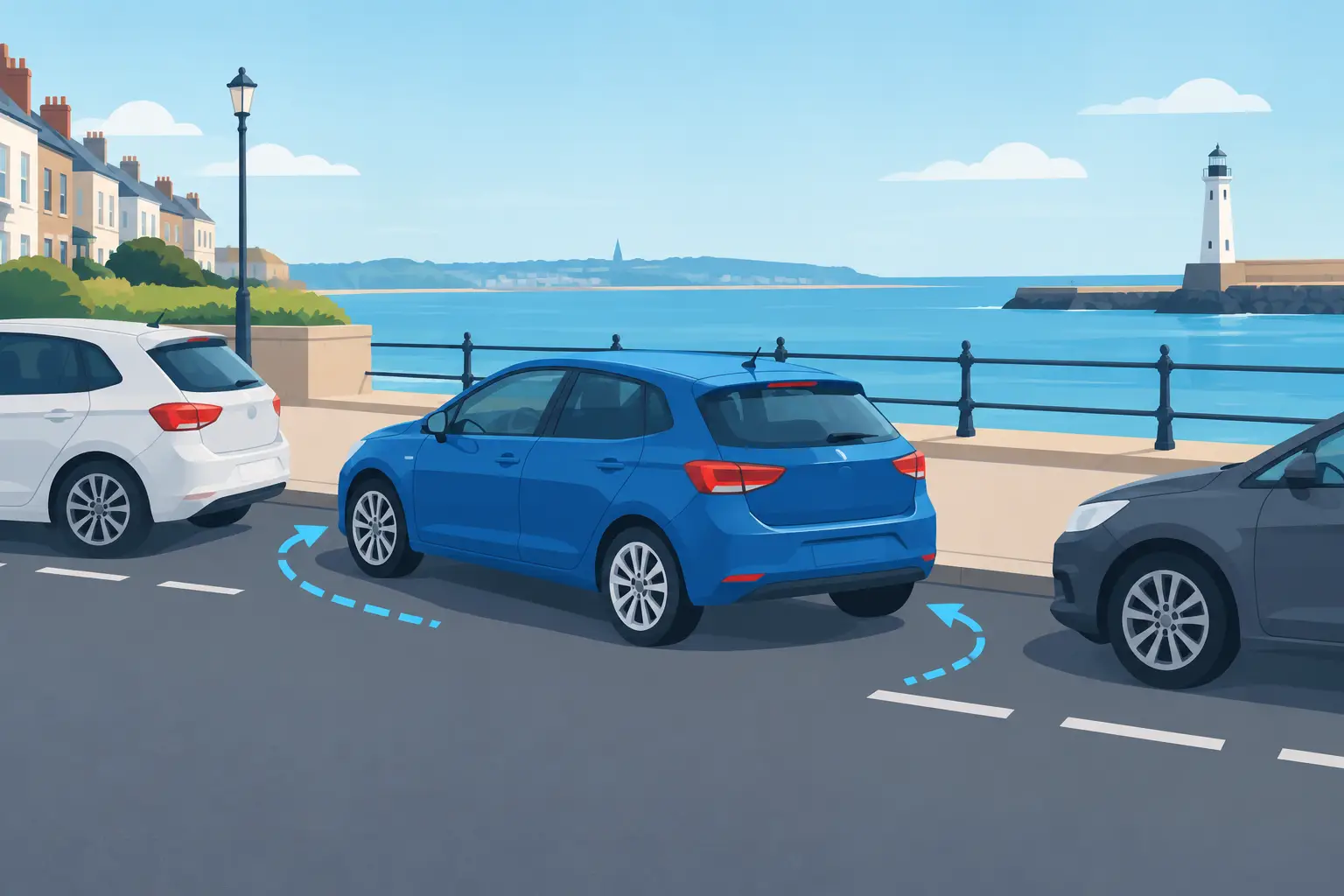
Parallel parking can feel like the manoeuvre everyone is watching, especially when you are learning on busy streets in South Shields. This guide to parallel parking breaks it into a calm, repeatable routine. The aim is not to squeeze into every small space or rush because traffic is waiting. It is to park safely, accurately and with proper observation.
For the practical driving test, the examiner is looking for controlled driving, appropriate checks and a safe final position. A neat result matters, but your awareness of pedestrians, cyclists, passing vehicles and the kerb matters more.
Before You Start the Parallel Park
Choose a space that is comfortably longer than your car when you are practising. Learning in a generous space allows you to understand the steering, positioning and observations without trying to solve several problems at once. As your control improves, you can work towards more realistic gaps.
Pull up alongside the vehicle in front of the space, leaving a sensible side gap – usually around half a metre where road conditions allow. Your car should be broadly level with it. Check ahead, behind and to the sides before stopping, as the position you take needs to be safe for everyone around you.
Select reverse only when you are ready to move. Reverse gear means you must treat observation as an ongoing task, not something completed with one quick look. Take time to set up properly. A few extra seconds at this stage often make the rest of the manoeuvre much easier.
Guide to Parallel Parking: A Simple Method
Every car has slightly different reference points, and every road has a different camber, kerb and amount of space. Your instructor can help you find reliable reference points in the manual car you are learning in. Rather than memorising a rigid script, understand what each stage is doing.
1. Prepare and observe
Use the correct observation routine before the car moves. Check your mirrors, look over the appropriate shoulder and assess whether anybody is approaching or likely to be affected. If a pedestrian, cyclist or vehicle is close, wait. There is no prize for reversing while somebody is trying to pass.
Keep the car moving slowly, using clutch control and brake control to stay at a pace where you can stop immediately if needed. In a manual car, this is one of the most useful chances to practise genuine low-speed control.
2. Reverse into the space at an angle
As the rear of your car begins to enter the space, steer towards the kerb using the reference point you have practised. Continue checking all around, particularly through the rear window and in the direction the car is moving.
Do not stare at one mirror. Mirrors help you judge your distance from the kerb and nearby vehicles, but they do not replace looking around the car. The view can change quickly, especially near schools, shops, parked cars and residential streets.
3. Straighten at the right point
Once the car reaches the appropriate angle, steer back the other way to guide it parallel with the kerb. This is the stage learners often rush. Slow down rather than adding more steering than necessary.
If you finish too far from the kerb, do not panic. You may be able to make a small, safe adjustment. If the angle is clearly wrong, it is usually better to drive forward carefully and reset than to keep reversing and hope it improves.
4. Finish safely and secure the car
Aim to finish reasonably close to and parallel with the kerb, without touching or mounting it. On the driving test, touching the kerb lightly is not automatically a serious fault, but mounting it or losing control can be. More importantly, it risks damaging a tyre, wheel or the kerb itself.
When parked, secure the car correctly. Apply the handbrake, select neutral and cancel any signal if it is still on. Before moving away again, carry out effective all-round observations and move only when it is safe.
What Makes a Parallel Park Safe?
Parallel parking is not just about where the car ends up. It tests planning, patience and your ability to share the road. You may need to pause during the manoeuvre if another road user appears. That is good judgement, not a failure.
Keep an eye on the whole picture. A car behind may wait, pass or become impatient. A cyclist may filter through the gap beside you. A pedestrian may step out from between parked cars. Your responsibility is to respond safely, even if another person is in a hurry.
Use a signal if it will help other road users understand your intention. Whether and when you signal depends on the situation. If there is nobody to benefit from it, a signal may not be needed. Your instructor will help you build the habit of deciding based on what is actually happening around you.
Common Problems and How to Correct Them
The most common issue is reversing too quickly. When the car is moving faster than walking pace, steering corrections become bigger, observations become rushed and the kerb arrives sooner than expected. Slow the car down first. Accuracy follows control.
Another common problem is turning the wheel too early or too late. Reference points help, but they are only guides. If the vehicle in front is parked at an unusual angle, or the road slopes, the point may need a small adjustment. Learn to look at the developing position of your car, not just a fixed point in the mirror.
Some learners focus so hard on avoiding the kerb that they finish a long way out from it. A reasonable finishing position is close and parallel, typically within about two car widths of the kerb at most, though closer is preferable where safe. If you are too far away, assess whether a controlled forward adjustment will improve your position.
Finally, do not assume you have failed because you needed a correction. The practical test allows you to correct a manoeuvre if you do it safely. What matters is whether you remain in control and maintain effective observation throughout.
Parallel Parking on the Driving Test
At Sunderland Driving Test Centre, as at any test centre, you could be asked to carry out a parallel park at a suitable point during the drive. You will be given clear instructions, usually to pull up on the right or left as appropriate and then reverse into a space behind a parked vehicle.
You are allowed to take your time. Listen to the instruction, ask if you did not hear it clearly, and focus on a safe routine rather than trying to predict the examiner’s view. You do not need to perform for traffic behind you. If it is safe to pause, pause.
Good test preparation includes practising on different types of road, not repeating one familiar parking bay until it feels automatic. Narrower residential streets, slight hills, different kerb heights and varying traffic all teach useful judgement. The goal is independent driving, not a manoeuvre that only works in one location.
Build Confidence Through Structured Practice
If parallel parking currently feels confusing, break it down during your lessons. First practise finding a safe stopping position. Then work on slow reverse control, steering at the right time and accurate finishing. Once those parts feel more familiar, add busier roads and realistic decisions about when to wait.
Two-hour manual driving lessons can give you enough time to practise the manoeuvre more than once without feeling rushed, while still developing the wider driving skills that make it safe. Recording your progress also helps you see what has improved and what needs more work before test day.
For learners in South Shields, particularly NE33 and NE34, calm local practice can turn parallel parking from a dreaded exercise into a useful everyday skill. If you are starting lessons, returning after a break or changing instructors, ProPasser offers patient, structured manual tuition with preparation based on demonstrated readiness. You can enquire about lesson availability by form, WhatsApp or telephone.
The best parallel park is rarely the fastest one. Give yourself space to observe, keep the car slow enough to control, and make the safe decision each time – confidence grows from doing that consistently.


